"And remind, for indeed, the reminder benefits the believers."
(Al-Quran 51:55)

Friday, 18 April 2014

Sunnahs of the Night

Assalamu alaikum wa rahmatullahi wa barakatuhu!

In the Name of Allah, Most Gracious, Most Merciful

A Sunnah is an action that was carried out by the Prophet Muhammad (saw). As Muslims, he is our role model in all aspects of life therefore we try to follow his ways in even the minutest detail.

Allah says in the Quran:

3:31

Say, (O Muhammad), "If you should love Allah, then follow me, so Allah will love you and forgive your sins, and Allah is Forgiving, the Merciful.
(Surah Aale-Imran)

The following are the Sunnah practices of the night:

1. To recite Bismillah while closing and locking the doors of the house.

2. Open food and water should be covered with the recitation of Bismillah. A stick could also be used to cover but Bismillah should be read.

3. To put out any burning fire.

4. To switch off or put out anything which may catch alight, if left on like a candle.

5. To discuss with members of the household matters relating to Islam, for example, telling stories about the Sahabah (ra). 

6. When children reach the age of 9 or 10 years, the beds of females should be separated from that of the males.

7. To apply surma 3 times in the right eye and 3 times in the left eye. Apply it on to the children also.

8. To lay or spread the bedding by yourself.

9. To dust the bed before sleeping.

10. To make miswaak even though one has already made miswaak for the Isha salah.

11. Before sleeping, recite with Bismillah each time:
and thereafter blow on the palms which should be rubbed 3 times on ones entire body - beginning from the head and ending at the toes.

12. To use pillows to rest ones head on. The Prophet Muhammad's (saw) pillow was made of leather and filled with date palm leaves.

13. To use leather and hide as bedding for sleeping.

14. To use a straw mat for sleeping.

15. To sleep on bedding.

16. To sleep on a mat or carpet made of cloth.

17. To sleep on the floor.

18. To sleep on a bed.

Note - sleeping on any of the above with the intention of Sunnah shall merit reward.

19. The Prophet (saw) prohibited lying downwards on the stomach.

20. The Prophet (saw) also prohibited lying flat on the back with one leg on the other. (If there is no fear of exposing the private parts then it is permissible to lie down in this manner).

21. To sleep on the right side, facing towards the Qibla.


22. To sleep with the right hand under the head and with the knees bent.

23. To recite the following duas when one lies down:
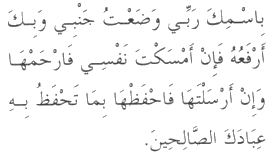


In Your name I have laid my side and with Your help I shall rise. If You withhold my life then forgive it and if You send it back then protect it as You would protect Your pious servants.


24. To recite the following Istighfaar 3 times:


I seek forgiveness from Allah besides whom there is none worthy of worship, the Living, the Sustainer (of life) and to Him I repent.

25. To recite any Surah from the Quran that one remembers especially Surah Al-Mulk, Surah As-Sajdah and Surah Yaseen. 

26. Reciting of Surah Al-Waqiah before sleeping safeguards one from hunger and poverty.

27. To sleep in a state of purity i.e. wudhu and ghusl (if necessary). If one has done wudhu before sleeping, then it would not be necessary to repeat it.

28. To recite Subhanallah 33 times, Alhamdulillah 33 times and Allahu Akbar 34 times. For full story, see here. Recite the Kalima Tayyibah once also:


29. To keep the prayer mat for the Tahajjud prayer besides the head before sleeping.

30. If one experiences a good dream and wishes to relate it to somebody then he should relate it to a learned and compassionate person so that it is interpreted correctly.

31. After a nightmare, one should recite once:


I seek protection with Allah from the accursed Shaytan.

and spit or blow on the left side 3 times. One should change the position that one was sleeping in, and should not mention such dreams to anyone, and inshallah, no harm shall come to that person.

32. To have water and miswaak ready in advance for wudhu.

33. To sleep with the intention of getting up for the Tahujjad prayer.

34. To read the Tahujjad prayer before the Fajr prayer.

35. Our Prophet Muhammad (saw) used to read such long rakaats for Tahajjud that his blessed feet became swollen. Whilst recting Quran in salah, he used to cry a lot due to which a sound used to come from his chest as if a pot of water is boiling. This was due to his fear of Allah.

36. For Tahajjud, pray at least 2 rakats and a maximun of 12 rakaats. This is the Sunnah. However, there is no limit for Nafl prayers. As many rakats can be prayed. One may also do Zikr, Tilawah and it is also permissible to sleep, provided that the Fajr prayer is not missed.

37. Zaid bin Thabit (ra) complained to the Prophet Muhammad (saw) about his sleepless nights. The Prophet (saw) advised him to read the following dua:

اللَّهُمَّ غَارَتِ النُّجُومُ وَهَدَأَتِ الْعُيُونُ وَأَنْتَ حَيٌّ قَيُّومٌ * لَا تَأْخُذُكَ سِنَةٌ وَلَا نَوْمٌ يَا حَيُّ يَا قَيُّومُ أَهْدِئْ لَيْلِي وَأَنِمْ عَيْنِي 
o Allah, the stars have sunk in and the eyes have become tranquil and quiet and You are alive and everlasting. Neither does sleep overcome You. O the live and everlasting One, make my night tranquil and give my eyes sleep.

May Allah give us all the ability to follow the Sunnah whenever the night falls - Ameen!

Wasalaam!

Wednesday, 16 April 2014

The Orphan and the Refugee

Assalamu alaikum wa rahmatullahi wa barakatuhu!

In the Name of Allah, Most Gracious, Most Merciful

Today two things came before me.

 The first were these beautiful and inspiring letters written by young Somali refugees to young Syrian refugees. A few examples are given below. (Full credit for the pictures go to the BBC News website).

A letter from a Somali refugee to a Syrian child. Includes lines such as "In future you can rebuild your country you will get peace and no longer be a refugee" and "I am really encouraging you not to lose hope".


Dahir Mohamed's letter has two hearts drawn on it, one with a flag of Somalia and another of Syria, with the words "brother and sister" in between


A letter from a Somali refugee to a Syrian child, including the lines: "We are feeling the same way that you are feeling", and "Try to start a new life which is much better than before"


The front of Zahra's letter, advising the Syrian refugees to work hard and "be polite"


A colourful heart has been drawn on a piece of paper


A letter from a Somali refugee to a Syrian child. Includes a list advising to "be patient", "respect their teachers" "help each other".


You can find the full article here.


The second thing was a nasheed that popped into my YouTube subscription this morning. 


Abu Hurayra reported that the Messenger of Allah, may Allah bless him and grant him peace, said, "The best house among the Muslims is the house in which orphans are well treated. The worst house among the Muslims is the house in which orphans are ill treated. I and the guardian of the orphan will be in the Garden like that," indicating his two fingers.

Ways to help orphans can be found here and here. To help refugees, take a look here.

May Allah help all the Muslims around the world, wherever they may be, and give us all the ability to help as much as we can - Ameen!

Wasalaam!

Tuesday, 8 April 2014

The Story of Zayd bin Haaritha (ra) and Zainab bint Jahash (ra)

Assalamu alaikum wa rahmatullahi wa barakatuhu!

In the Name of Allah, Most Gracious, Most Merciful

33:36

It is not for a believing man or believing woman, when Allah and His Messenger have decided a matter, that they should (thereafter) have any choice about their affair. And whoever disobeys Allah and His Messenger has certainly strayed into clear error.

33:37

And (remember O Muhammad) , when you said to the one on whom Allah bestowed favour and you bestowed favour, "Keep your wife and fear Allah", while you concealed within yourself that which Allah is to disclose. And you feared the people, while Allah has more right that you fear Him. So when Zayd had no longer any need for her, We married her to you in order that there not be upon the believers any discomfort concerning the wives of their adopted sons when they no longer have need of them . And ever is the need of Allah accomplished. 

 33:38

There is not to be upon the Prophet any discomfort concerning that which Allah has imposed upon him. (This is) the established way of Allah with those (prophets) who have passed on before. And ever is the command of Allah a destiny decreed.

33:39

(Allah praises) those who convey the messages of Allah and fear Him and do not fear anyone but Allah. And sufficient is Allah as Accountant. 

(Surah Al-Ahzab, Verses 36-39)

Many Arabs used to kidnap children and take them to distant places, where none recognised them. They would then sell them as slaves. Zayd bin Haaritha (ra) was travelling with his mother to her parents home when some bandits kidnapped him and took him to Makkah, where they sold him as a slave. He was 8 years old at the time. Hakeem bin Hizaam bin Khuwaylid (ra) bought him as a gift for his paternal aunt, Khadijah (ra). He paid 400 dirhams for the boy.

When Khadijah (ra) married the Prophet Muhammad (saw), she presented Zayd (ra) as a gift for her husband. The Prophet (saw) adopted him as a son and people began referring to him as Zayd bin Muhammad (Zayd, the son of Muhammad) because it was customary among the Arabs to refer to an adopted child as the real child of the adoptive father. 

When Zayd's (ra) father learnt after much investigation that his abducted son had been sold as a slave in Makkah, he arrived in Makkah to purchase his freedom. When he approached the Prophet (saw) and explained that he wished to purchase his son's freedom, the Prophet (saw) told him that he may take the boy for free if the boy agreed to accompany him. However, the boy should be left to remain with the Prophet (saw) if he chose to do so.

Exuberant, the father said that the Prophet (saw) had exceeded the bounds of kindness because the Prophet (saw) reserved the right to retain the boy. When the Prophet (saw) asked Zayd (ra) if he recognised the two persons who came to fetch him, he immediately responded by saying that they were his father and uncle. 

The Prophet (saw) told him, "You know them and you know me because you have spent time in my company. You now have the choice to join them or to remain with me". Zayd (ra) chose to remain with the Prophet (saw). His father said, "It is tragic that you prefer a life of slavery to freedom and another person to your father, uncle and family". Zayd (ra) replied, "I have seen such qualities in my master and I simply cannot prefer any other to him".

This episode took place before the Prophet (saw) announced his prophethood. When Muhammad (saw) announced that he was a prophet, Zayd (ra) was one of the first to accept Islam.

The Prophet (saw) married Zayd (ra) to his slave, Barka (ra) famously known as Umm Ayman (ra). She was of African origin and it was she who brought the Prophet (saw) back to Makkah from Abwa after his mother passed away when he was only 6 years old. Umm Ayman (ra) gave birth to Usama bin Zayd (ra), who was commonly referred to as the 'beloved of the Prophet (saw)'.

People always referred to Zayd bin Haaritha (ra) as Zayd bin (the son of) Muhammad. However they stopped doing so when Allah revealed the verse:

33:4

Allah has not made for a man two hearts in his interior. And He has not made your wives whom you declare unlawful your mothers. And He has not made your adopted sons, your (true) sons. That is (merely) your saying by your mouths, but Allah says the truth, and He guides to the (right) way.

33:5

Call them by (the names of) their fathers; it is more just in the sight of Allah. But if you do not know their fathers, then they are (still) your brothers in religion and those entrusted to you. And there is no blame upon you for that in which you have erred but (only for) what your hearts intended. And ever is Allah Forgiving and Merciful.

(Surah Al-Ahzab, Verses 4 and 5)

The Prophet (saw) then married Zayd (ra) to his cousin, Zainab bint Jahash (ra). She was the daughter of the Prophet's (saw) paternal aunt. She accepted the proposal on the Prophet's (saw) recommendation, but the couple could never adapt to each other. When Zayd (ra) wanted to divorce her, the Prophet (saw) advised him to maintain the marriage. However, when matters came to a head, he finally divorced her. 

Allah then commanded the Prophet (saw) to marry her, when He revealed the verse,

"So when Zayd fulfilled his need from her, We married her to you .."

After completing the Iddah, the Prophet (saw) sent a marriage proposal to her via Zayd (ra), but she requested time to to consider the matter. However, when Allah revealed the above verse, the marriage was contracted and the Prophet (saw) was legally married to her. It is for this reason that she boasted to the other wives of the Prophet (saw) saying,

"Your guardians married you whereas Allah Himself married me".

Wasalaam!

Tuesday Morning Inspiration

Assalamu alaikum wa rahmatullahi wa barakatuhu!

In the Name of Allah, Most Gracious, Most Merciful

I was going through my photo folders and found the following. I hope they are of use to you :)


This nasheed is really peaceful - I hope you like it as much as I do. If anyone knows the meaning, please let me know!


Have a blessed day!

Wasalaam!

Thursday, 20 March 2014

Is It Really Allah?

Assalamu alaikum wa rahmatullahi wa barakatuhu!

In the Name of Allah, Most Gracious, Most Merciful

Internal poverty is the poverty of the soul. It describes the unmoved soul. The soul that has been created but has failed to realize why. It is the soul that lives a life without purpose. The heart that beats but has already died. 

Because while this body cries and bleeds and feels pain from the material world, the soul is untouched by these things. There is only one thing that can cut, stab or impoverish the soul. There is only one thing that can kill it. To deprive it of its only one true need. That is for it to be close to its originator. To be near Allah.

Spiritual deprivation is the true impoverishment. True poverty is standing poor on the Day of Judgement. Despite this reality, we continue to live this life, feeding our bodies but starving our souls.

When a body dies, we cry. But our hearts are unmoved by those bodies which are still alive but whose hearts and souls have already died. Because of the alienation from that which gives life - Allah. 

What impoverishes and kills the heart? It is allowing the heart to love anything as it should only love Allah. The heart was created by and for Allah. The heart was created to know and love Allah. The heart was created to be given to Allah and to be filled with His remembrance.

The heart that is given to or filled by any other thing suffers the most painful impoverishment and death. The heart that is owned by this life is a prisoner of the worst kind. The heart that is owned by any other master than the Master of masters, is the weakest of all slaves. 

That is true oppression, true death, true poverty. 

As human beings, we enslave ourselves to different things. Some are enslaved to money or to other people. We love them as we should only love Allah. Some of us are enslaved to our status in society or to our careers. 

What do you love most? 

Many of us will say that we love Allah the most. We say this with our tongues and in our minds. But our hearts and actions say otherwise. 

How do you know what it is that you love the most?

Ask yourself, what is your refuge? When you are most broken, where do you go? When you afraid, where do you hide? When you need, who do you ask? What do you fear most? What do you stay up at night worrying about? What makes you cry most? What do you think about most? What occupies your mind in salah? 

Is it really Allah?

Is it really Allah on our mind the most? Is it really your fear of standing before Him that makes you cry in your bed? 

No, probably not.

It's the person who left you, the money you lost, the career you couldn't have, the pay rise you didn't get. What are you afraid of most? Just the thought of losing that object causes you so much anxiety that you feel it physically? 

Is it your husband? Your wife? Your money? Your job? Is it your image? Your figure? What is it? 

When you are given a choice, what do you do? When Allah says to dress and act a certain way, and then society says the opposite, which do you choose? Who defines beauty for you? Who defines success? 

When Allah says that interest is haraam, but your financial ambitions command otherwise, which do you choose? Who defines richness? Who defines poverty? 

The storm is coming. Seek refuge in the only place that refuge exists. Seek refuge in Allah. 

You and I know what day we were born. But none of us know on which day we will die. And, many people think that we can live our lives in whichever way we like. Then at the time of death, just read the Kalimah. 

But at the time of death, the tongue cannot speak except what the heart commands. Whatever is in the heart, it will come out. 

The impoverished heart will have nothing but the love of the world to speak about on that day. If our heart is empty of Allah during our life, how can it be full of Allah during our death?

If in your life, you carried only La ilaha illallah that truly there is no refuge, no shelter but Him. Then and only then will the tongue be given permission to say the Kalimah.

May Allah make us amongst them who truly take Allah as their refuge - Ameen!

(Adapted from a speech by Yasmin Mogahed)

Wasalaam!

Tuesday, 11 March 2014

Virtues of Surah Al-Faatiha

Assalamu alaikum wa rahmatullahi wa barakatuhu!

In the Name of Allah, Most Gracious, Most Merciful

First, let us look at the beautiful meaning of this Surah:

1:1
In the Name of Allah, Most Gracious, Most Merciful

1:2

All praise is only for Allah, the Lord of the universe.

1:3

The Beneficent, the Most Merciful

1:4

Master of the Day of Retribution

1:5

Only You do we worship, and only You do we ask for help.

1:6

Guide us upon the straight path.

1:7

The path of those whom You have favoured, not the path of those who have incurred Your wrath, nor those who have gone astray.

Allah mentions Surah Al-Faatiha in Surah Hijr:

15:87

Verily, We have granted you seven verses that are often repeated, and the Glorious Quran.
(Surah Al-Hijr, Verse 87)

The Prophet Muhammad (saw) has said:
"Surah Al-Faatiha is the greatest Surah in the Quran".
(Bukhari - Vol. 2 - Pg. 642)

Tirmidhi reports that the Prophet (saw) said:
"By Allah! Such a Surah (Al-Faatiha) has not been revealed in the Torah, nor in the Injeel, nor in the Zaboor, nor in the Quran".

Abu Umamah (ra) reports from the Prophet (saw) that only 4 things were revealed from the treasures that lie beneath Allah's Throne. These are:

Hadhrat Abdul Malik bin Umair (ra) narrates that the Prophet (saw) said:
"Faatihatul Kitaab (Surah Al-Faatiha) is a cure for everything".
(Durrul Manthoor)

Hadhrat Anas (ra) reports that the Prophet (saw) said:
"When any of you lies down to rest at night, he will be safe from everything besides death if he recites Faatihatul Kitaab and Surah Al-Ikhlas.
(Durrul Manthoor)

May Allah give us all the ability to recite Surah Al-Fatiha with real consideration as to its virtues and meaning - Ameen!

Wasalaam!

Thursday, 6 March 2014

Make Every Day a New Beginning

Assalamu alaikum wa rahmatullahi wa barakatuhu!

In the Name of Allah, Most Gracious, Most Merciful

Staying away from Allah, the Exalted, only brings bitter fruit. The gifts of intelligence, strength, beauty and knowledge will all turn to calamity and loss if they are kept away from the guidance of Allah, the Exalted, and deprived of His blessings.

It is for this reason that Allah has warned people of the consequences of staying away from Him.

If you are walking down the street and a car comes towards you at high speed and you feel it will hit you and kill you, you have no choice but to act quickly and try to get away.

Allah wants to warn His slaves that they face a similar kind of destruction if they turn away from Him, so He urges them to seek safety with Him alone:

51:50
51:51

So flee to Allah. Indeed, I am to you from Him a clear warner.
And do not make (as equal) with Allah another deity. I am to you from Him a clear warner.
(Surah Adh-Dhariyat, Verses 50 and 51)

Turning to Allah requires a person to:
1. Renew herself
2. Reorganize her life
3. Develop a better relationship with her Lord
4. Do better deeds

It is the start of a new covenant and way of life that is summed up in the following dua:


O Allah, you are my Lord and there is no god but You. You created me and I am your slave. And I am trying my best to keep my oath (of faith) to You and to live in the hope of Your promise.
I seek refuge in You from my greatest evil deeds. I acknowledge Your blessings upon me and I acknowledge my sins. 
So forgive me, for none but You can forgive sins.

Allah says: "I am as My servant thinks I am".

Wasalaam!